
If you have shipped LTL to Russia more than a few times, you have probably been asked this question at the loading stage: Khorgos or Manzhouli this time? Both crossings can move your cargo. The quotes are often close. But once the truck actually rolls, the two gateways operate on different consolidation logics, different congestion patterns, and different hidden cost structures.

We run warehouses at both Khorgos and Manzhouli, and our own TIR fleet moves LTL consolidation through each node daily. This is not a which gateway is faster answer in one sentence. It is a breakdown of the decisions that actually matter for LTL shippers—declaration mechanics, queue dynamics, and the cost items that do not appear on the first quote.

The fundamental difference between FTL and LTL at the border is the number of declarations tied to one truck. FTL is one shipment, one truck. LTL is multiple shipments on one truck. Whether a gateway’s customs mechanism can handle multiple shipments determines whether your cargo can board smoothly.
Manzhouli has something Khorgos does not currently offer at the same operational maturity: one truck, multiple declarations. This model landed in Manzhouli in 2026. One TIR truck can correspond to multiple customs declarations. Cargo from different shippers, in different commodity categories, is declared separately and loaded onto the same outbound vehicle. In a documented case, a single truck carried small appliances, footwear, accessories, and household goods—over 3,500 items with a value of roughly RMB 1.2 million—with each shipment declared on its own paper, without dragging the others down.
What does this mean in practice? If your LTL shipment is the multi-shipper, multi-category, mixed-value kind of consolidation, Manzhouli’s declaration logic fits naturally. You do not need to bend your commodity description or declared value to match someone else’s paperwork just to get on the truck. Loading can be maximized while the customs friction per shipment goes down, not up. When we consolidate at our Manzhouli warehouse, this directly shapes the operational rhythm: cargo can enter the warehouse on its own timeline instead of waiting for every shipment to be complete before a single declaration can be filed.
Khorgos runs on a different logic. It crosses into Kazakhstan and then into Russia under a TIR carnet, with the core advantage being no transloading and no de-consolidation at the border. The trailer stays sealed from the Chinese consolidation warehouse all the way to the destination customs post in Russia. But its customs rhythm is more dependent on whole-truck compliance consistency. SPOT electronic pre-declaration is filed at the truck level, and under the 2026 rules the Russian importer must submit the pre-arrival declaration to the Federal Tax Service 2 to 7 days before the truck reaches the border, with a deposit covering 20% VAT plus applicable excise tax. A compliant truck with SPOT pre-declaration and all fees settled can clear Khorgos in roughly 24 hours. Without it, the truck sits at the border, and so does every LTL shipment on board.
There is one more compliance layer on the Khorgos route that LTL shippers rarely factor in until it becomes a problem: Kazakhstan’s electronic navigation seal, mandatory since July 31, 2026. Transit trucks must carry a seal that tracks position across Kazakh territory, and unauthorized route deviation triggers penalties. The forwarder is responsible for fitting and registering it—but for an LTL shipper, the operational implication is that the truck’s route through Kazakhstan is no longer discretionary. If a driver detours for any reason, the seal records it, and the delay or fine lands on the whole truck.

LTL shippers are sensitive to congestion because every extra day on the road adds uncertainty to warehouse turnover and downstream delivery. But Khorgos and Manzhouli jam for different reasons, and the mitigation is different.
Khorgos congestion is road-side traffic volume. In the September 2026 peak season, on-site queues at Khorgos stretched to 8–10 days, while Alashankou on the same western corridor saw around 7 days. Khorgos is one of the busiest road crossings between China and Kazakhstan. Its transit advantage—7–13 days to the Urals/Siberia and 10–16 days to Moscow for compliant TIR—is built on the assumption that the truck clears on schedule. When queueing extends, door-to-door LTL time absorbs that delay directly. There is another LTL-specific variable: consolidation wait. Cargo consolidated from Urumqi or Kuitun and dispatched via Khorgos to Almaty typically takes 7–10 days for LTL versus 3–5 days for FTL, and the gap is largely waiting for enough cargo to fill the truck. The transit numbers you see on a rate sheet do not include either the queue or the wait.
Manzhouli congestion is primarily rail transloading congestion, not TIR road congestion. The Manzhouli–Zabaikalsk rail crossing has seen transloading queues stretch to around 20 days in peak season, with paid slots still taking 5–7 days. That is precisely where TIR road has a structural advantage at Manzhouli: a TIR truck does not transload. The rail transloading queue and the road TIR lane are not the same queue. In the first eight months of 2026, Manzhouli road port processed 3,062 TIR vehicle trips, the highest nationally, supported by 7×24 customs appointment and a dedicated TIR verification area that lifted port throughput by around 40%. And in September 2026, after the annual China–Russia road transport permits were replenished, the on-site queue at Manzhouli dropped to 3–4 days—shorter than both Khorgos and Alashankou during the same window.
So the LTL takeaway is this: if rail transloading queues at Manzhouli are scaring you during peak season, that does not mean TIR road is jammed on the same queue. Conversely, Khorgos’s transit advantage is real, but it has less tolerance for queueing, because LTL cargo has already spent part of its time budget in the consolidation phase.
Rate sheets for LTL via Khorgos and Manzhouli can look close at first glance—roughly $160 per CBM on the Manzhouli route and around $190 per CBM on the Khorgos route in 2026 indicative pricing. But two hidden cost items routinely change the final calculation, and they hit LTL shippers differently than FTL.
On the Manzhouli side, there is a guarantee fee—a China-side deposit charged at roughly 3‰ of the total cargo value on the truck. For a high-value LTL consolidation—electronics, precision parts, branded goods—this line item can add meaningful cost that a per-CBM quote does not show. On the Khorgos side, the extra cost is less about a single fee and more about delay exposure. A white-customs pre-declaration failure at Khorgos does not just add queue time; it can hold the truck for days and push the landed cost above the eastern route. One documented case from 2026 involved a shipper who chose Khorgos expecting a smoother clearance, had the pre-declaration rejected, lost five days at the border, and ended up 12% more expensive than the Manzhouli routing he had abandoned.
For LTL, the cost picture is further complicated by consolidation density. A per-CBM rate assumes your cargo fills volume efficiently, but LTL consolidation often involves mixed densities—light bulky goods sharing space with dense cargo. The gateway decision should be made on landed cost per shipment, not on the headline per-CBM rate, and that means factoring in the guarantee fee on one side and the delay-risk premium on the other.
Put the variables together—declaration mechanism, congestion type, and hidden costs—and the decision breaks into concrete situations.
If your LTL is multi-shipper, multi-category, and needs separate declarations, Manzhouli’s one truck, multiple declarations is the more frictionless customs mechanism available today. When shipment values and commodity types vary widely, separate declarations keep one problematic shipment from stalling the whole truck. We handle this type of consolidation more frequently at our Manzhouli warehouse, and the operating rhythm is more mature for it.
If your cargo is headed to the Urals/Siberia (Yekaterinburg, Novosibirsk direction), is time-sensitive, and you can absorb Khorgos queue variability, TIR via Kazakhstan is competitive when compliance is in place: 7–13 days door-to-door to the Urals/Siberia, with LTL rates around $1.8–3.0/kg and roughly a week faster than rail LTL, without the cargo-damage exposure of repeated rail transloading. The condition is that SPOT pre-declaration must be completed 2–7 days before the truck reaches the border, not after, and the Kazakh navigation seal must be fitted correctly before departure.
If you are shipping between November and March, separate the two gateways’ seasonal patterns. Khorgos queueing stretches during peak and e-commerce volume surges. Manzhouli rail transloading congestion is at its worst in this window, but TIR road’s no transloading nature makes it a usable diversion option precisely when rail is most jammed. If your cargo is not urgent and you are willing to trade a few days for a lower rail cost, that is a different calculation. But if your LTL consolidation cannot afford a 20-day rail transloading queue, TIR road via Manzhouli deserves a place in your contingency plan.
If Khorgos queues beyond your buffer, Alashankou and Dulata are alternative westward crossings. But switching has its own cost: re-arranging consolidation, re-confirming the overseas receiving truck, and disrupting the LTL wait-for-cargo rhythm. That is why LTL gateway selection is not only about which side is faster, but also about where your cargo consolidates more smoothly and which switch is less disruptive to your flow.
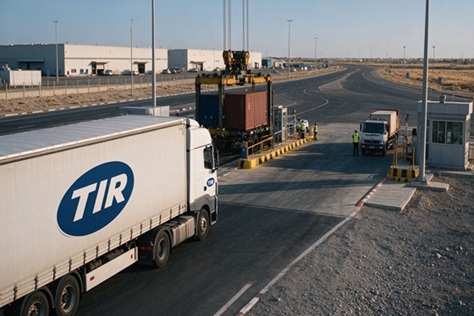
We keep warehouses at both Khorgos and Manzhouli—alongside our Yiwu consolidation hub—not to say we can do either, but because the two routings serve different LTL cargo profiles. Khorgos suits time-sensitive consolidation headed toward the Urals/Siberia, where the shipper is willing to pay for sealed, no-transload transit and can plan around queue variability. Manzhouli suits multi-shipment, multi-category LTL that benefits from separate declarations, or cargo that needs a road alternative when rail transloading is at its worst. The choice is not permanent; the same shipper may use both gateways in the same quarter for different orders.
If you are unsure where your LTL should be consolidated, send over the commodity, volume/weight, destination city, and approximate shipping window. We will give you a read based on the actual queue and consolidation rhythm at both gateways over the past two weeks—not a generic both work transit range. For a broader look at how our LTL service is structured across both nodes, see our Less-than-truckload (LTL) shipping page. If your LTL involves temperature-controlled cargo, the gateway decision also interacts with our TIR cold chain LTL capabilities, where equipment availability and border dwell time affect temperature risk differently at each node.

 IPv6 ПОДДЕРЖИВАЕТСЯ СЕТЬЮ