When shipping goods from China to Russia, the transportation price is not always the final cost. Import customs clearance, duties, VAT and delivery arrangements can all affect what the buyer eventually pays.
This is why understanding DDP and DAP matters.
Both terms can be used when a seller arranges transportation to a destination in another country. However, they are quite different when it comes to import customs clearance and taxes.
For Russian importers buying from China, choosing the wrong delivery term can lead to unexpected costs, delays and disagreements over who is responsible for customs procedures.
Let's look at how DDP and DAP work, what each party needs to pay, and what importers should check before arranging a shipment.
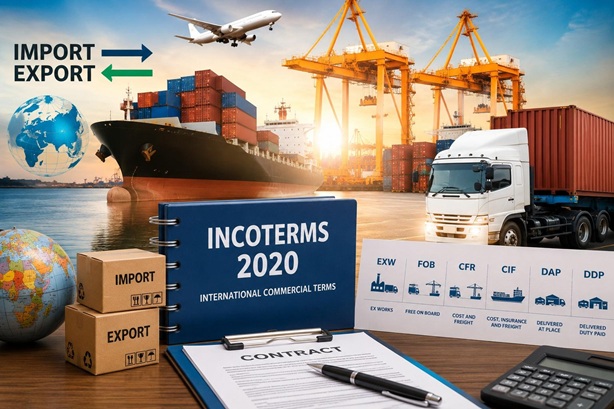
DDP stands for Delivered Duty Paid. It is one of the eleven delivery terms defined under Incoterms® 2020 by the International Chamber of Commerce (ICC).
Under DDP, the seller takes responsibility for arranging transportation, completing export and import customs formalities, and paying the applicable import duties and taxes.
The goods are delivered to the buyer at the agreed destination, ready for unloading.
For example, imagine a Russian company purchasing machinery from a manufacturer in China.
If the contract specifies DDP Moscow, the Chinese seller is responsible for arranging transportation to the agreed location in Moscow, handling export procedures in China, arranging Russian import customs clearance and paying the applicable import duties and VAT.
The Russian buyer does not normally need to arrange or pay for these import procedures separately.
However, there is an important detail: the seller must be able to legally and practically complete or arrange import clearance in Russia. This should be confirmed before agreeing to DDP.
A DDP quotation should also clearly state the named delivery location and any services or expenses that are excluded.
For the official definition, see the ICC Incoterms® 2020 rules.
A DDP shipment from China to Russia involves more than simply booking a truck.
The transportation provider, seller and relevant customs parties need to coordinate several stages.
Before arranging transportation, the parties need to confirm:
Product name and quantity
Cargo weight and dimensions
Pickup and delivery addresses
Product HS code and customs requirements
Required delivery schedule
These details affect both the transportation arrangement and the customs process.
The necessary commercial and transportation documents need to be prepared before the goods leave China.
Depending on the cargo, these may include:
Commercial invoice
Packing list
Sales contract
Export customs declaration
Product certificates or permits, where required
Incorrect product descriptions or incomplete documents can cause problems later, particularly when the shipment reaches a border checkpoint.
Once the shipment is ready, the seller arranges transportation to the agreed destination.
For China–Russia cargo, international road transportation is one option.
TIR direct truck transportation can be particularly useful when the cargo needs to move across borders with fewer unnecessary handling operations.
The exact route depends on the pickup location, destination, cargo characteristics and current border conditions.
The goods must go through the applicable import customs procedures in Russia.
Under DDP, the seller is responsible for arranging this process and paying the applicable import duties and taxes.
The parties should establish in advance who will legally act as the importer and how the customs declaration and tax payments will be handled.
After the required import procedures have been completed, the goods are delivered to the named destination.
Under DDP, the goods are made available to the buyer ready for unloading. Unloading is generally the buyer's responsibility unless otherwise agreed.
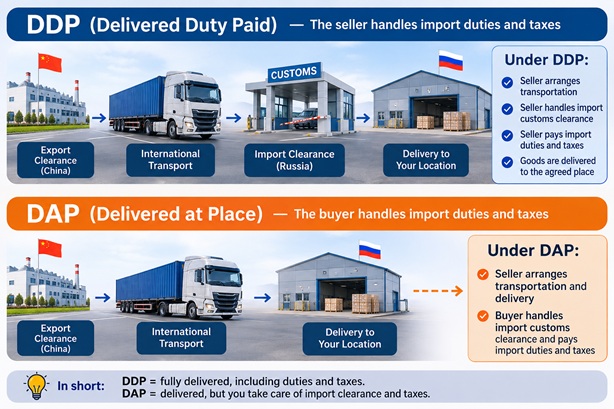
DDP and DAP are often confused because transportation is arranged by the seller under both terms.
The main difference is who takes responsibility for import customs clearance and the associated duties and taxes.
| Responsibility | DDP | DAP |
|---|---|---|
| Export customs clearance | Seller | Seller |
| International transportation | Seller | Seller |
| Import customs clearance | Seller | Buyer |
| Import customs duties | Seller | Buyer |
| Import VAT | Seller | Buyer |
| Delivery to agreed destination | Seller | Seller |
| Unloading | Normally buyer | Normally buyer |
Under DDP, the seller takes responsibility for the import customs process and applicable import duties and taxes.
This can be convenient for buyers who do not want to manage the import process themselves.
However, it also means that the seller must understand the destination country's customs and tax requirements and have a workable arrangement for completing import formalities.
Under DAP (Delivered at Place), the seller arranges transportation and delivers the goods to the agreed destination.
The buyer is responsible for import customs clearance, duties and applicable taxes.
For example, a Chinese supplier ships industrial equipment to a Russian warehouse under DAP terms.
The supplier arranges the international transportation. Once the goods arrive at the agreed destination, the Russian buyer handles import customs clearance and pays the applicable duties and VAT.
This arrangement is often more practical when the Russian buyer already has an established customs broker or an experienced import department.
For the official comparison, see the ICC explanation of DAP and DDP.
This is usually the first thing importers want to know when comparing DDP and DAP.
The answer is straightforward:
Under DDP, the seller is responsible for applicable import duties and taxes.
Under DAP, the buyer is responsible for applicable import duties and taxes.
Let's take a simple example.
A Russian importer purchases machinery from China with a customs value of USD 30,000.
For illustration, assume the applicable import duty rate is 5%.
The import duty would be USD 1,500.
This is only an example. Actual customs duties depend on the product's HS code, customs classification, customs value and applicable regulations. Import VAT is calculated separately according to the relevant rules.
Under DDP, the seller is responsible for the applicable import duty and VAT.
Under DAP, the Russian buyer pays these amounts.
There is another detail worth remembering: the lowest transportation quotation is not necessarily the cheapest overall option.
A DAP quotation may look lower because import duties and VAT are not included in the seller's responsibilities. Buyers should compare the total landed cost rather than looking at freight charges alone.
A DDP quotation should account for the costs and responsibilities required to deliver the goods to the agreed destination.
Depending on the shipment, these may include:
Transportation expenses
Cargo pickup in China
Domestic transportation
International road freight
Delivery to the agreed destination
Customs-related expenses
Export customs clearance
Import customs clearance
Applicable import duties
Import VAT and other applicable import taxes
Other agreed expenses
Required documentation
Customs-related services
Transit expenses
Special handling or delivery arrangements
Not every additional service is automatically included.
For example, unloading, storage, cargo insurance and special handling should be clarified separately.
When reviewing a DDP quotation, ask for a breakdown of the costs. It should be clear which expenses are included and which are excluded.
A DDP quotation can look attractive, especially when the buyer wants a simple delivery arrangement.
But before accepting it, there are several practical points worth checking.
This is particularly important for shipments from China to Russia.
Ask the seller who will arrange the import declaration and whether the proposed arrangement complies with Russian and applicable EAEU customs requirements.
A seller should not promise DDP simply because a transportation company can deliver the cargo across the border.
Some quotations use the phrase "all-inclusive" without explaining exactly what that means.
Ask whether the quoted amount includes applicable import duties, VAT, customs brokerage and other destination charges.
Make sure these responsibilities are written into the contract.
The HS code affects customs classification and the applicable import duty rate.
An incorrect classification or incomplete product description may lead to additional checks, delays or changes to the customs charges.
It is better to verify these details before the goods leave China.
"Delivery to Moscow" is not always specific enough.
A warehouse on the outskirts of Moscow and an address in the city centre may involve different delivery arrangements and costs.
Always confirm the exact address and unloading responsibilities.
Importers should understand who is responsible for additional storage, waiting time or other expenses if customs procedures are delayed.
These details are particularly important for time-sensitive cargo.
Understanding DDP and DAP is only part of planning an international shipment.
The transportation route, cargo type, border procedures and delivery schedule also affect the final result.
For companies shipping from China to Russia, TIR road transportation is one option worth considering.
Unlike conventional arrangements that may involve multiple handling stages, TIR transportation uses customs-sealed cargo compartments under the international TIR system. This can reduce unnecessary cargo handling during transit.
However, TIR and DDP serve different purposes.
TIR facilitates international customs transit. It does not automatically complete Russian import customs clearance or mean that import duties and VAT have been paid.
At DR Trans, we focus on international freight transportation, particularly China–Russia TIR road transport.
Our services include:
International TIR truck transportation
Full truckload and less-than-truckload transport
Own truck fleet
Cargo loading and securing arrangements
GPS tracking and shipment updates
Customs documentation and related logistics coordination
The exact transportation and customs arrangements depend on the cargo, destination and import requirements.
In April 2026, DR Trans published a shipment case involving a full truckload of vacuum cleaners and steam cleaners.
The cargo was collected from a factory in Suzhou and transported to a warehouse near Moscow.
The shipment took 10 days.
What made this shipment interesting was not simply the transit time. The customer had a sales promotion approaching and needed the products to reach the Russian market on schedule.
Rail transportation was expected to take around three weeks, while air freight was not an economical option for this type of cargo.
DR Trans arranged TIR road transportation for the shipment.
The cargo was transported in a sealed trailer, with the customs seal remaining intact during transit. The shipment reached its destination without reported cargo damage.
This is one example of how direct road transportation can help importers manage delivery schedules.
The 10-day transit time was specific to this shipment and should not be treated as a guaranteed delivery time for every route or cargo type.
Read the full case study: Shipping Home Appliances from China to Russia in 10 Days.
When shipping goods from China to Russia, the choice between DDP and DAP affects more than just the freight price. It also determines who handles import customs clearance and pays the duties and taxes.
DR Trans handles China–Russia road transportation, with its own truck fleet and TIR direct transport services. We work with different types of cargo, from household appliances to machinery and industrial materials.
For DAP shipments, we arrange transportation from China to the agreed destination in Russia. The Russian buyer takes care of import customs clearance and pays the applicable duties and VAT.
With DDP shipments, the seller is responsible for both delivery and Russian import duties and taxes. Before confirming a shipment, it is important to establish who will handle the import declaration and how the customs charges will be paid. These details need to be agreed in advance rather than assumed to be included in the freight price.
Whether you are shipping a full truckload or smaller cargo, DR Trans can help arrange a suitable China–Russia transport solution. Tell us where the goods need to be collected, what you are shipping and where they need to go, and our team can discuss the available options with you.
Neither option is automatically better. It depends on how the seller and buyer want to divide their responsibilities.
DDP may be suitable when:
The buyer prefers the seller to handle import customs clearance.
The seller can legally arrange import procedures in the destination country.
Import duties and taxes are included in the agreed delivery arrangement.
The buyer wants fewer import-related administrative tasks.
DAP may be suitable when:
The buyer already has a customs broker.
The buyer has experience with Russian import procedures.
The buyer prefers to manage customs declarations and tax payments.
The seller is responsible mainly for transportation and delivery.
Before signing the contract, specify the exact destination and Incoterms version.
For example:
DDP [Named Place], Incoterms® 2020
DAP [Named Place], Incoterms® 2020
This helps both parties understand where the seller's delivery obligation ends and which costs remain the buyer's responsibility.
DDP and DAP are not just two different ways of writing a freight quotation. They determine who is responsible for important parts of the international shipping process.
Under DDP, the seller handles import customs clearance and applicable import duties and taxes. Under DAP, the buyer takes responsibility for these import procedures and payments.
For Russian importers purchasing goods from China, the most important thing is to understand the actual customs arrangement before agreeing on a delivery term.
And when it comes to transportation, choosing the right route and logistics partner can make a real difference to delivery time, cargo handling and shipment visibility.
DR Trans provides China–Russia road freight and TIR transportation solutions, supported by its own truck fleet and logistics team.
If you are planning to ship machinery, industrial materials, household appliances or other cargo from China to Russia, contact DR Trans to discuss your cargo details, transportation options and delivery requirements.
Request a China–Russia transportation quotation from DR Trans.

 IPv6 ПОДДЕРЖИВАЕТСЯ СЕТЬЮ